Home Buying: Women like Pride, Men like Control…

I came across an interesting article last week about how men and women see about the home buying aspect and process itself. Check it out, it is an interesting read.

Men are from Mars, women are from Venus — and that couldn’t be more true when it comes to home buying. According to Prudential Real Estate’s third-quarter Consumer Outlook Survey, men and women are quite different when it comes to what they value most about home ownership and the process of buying and selling.

Women enjoy the home search more than men, with 87 percent of women versus 77 percent of men saying they like looking at homes, the survey finds. More women associate home ownership with “pride,” “accomplishment,” or “independence,” while men tend to associate it with “control over living space” and “more space for my family.”

“As the real estate market strengthens and household formation grows, men and women approach the buying-selling process from different angles,” says Earl Lee, president of Prudential Real Estate. “What’s most interesting is the dynamic that exists among couples and the role that agents play in balancing couples’ real estate objectives.”

Agents may often find themselves stuck in the middle, but both sexes say they trust their agent to be the voice of reason and settle any disagreements among couples. Eighty-three percent of survey respondents say their real estate agent was helpful in moderating an agreement, and 86 percent value the agent’s point of view as much as — or more than — their partner’s, according to the survey. Both sexes cited “honesty” and “knowledgeable” as the most important traits in a real estate agent.

Men and women tend to take on different responsibilities when it comes to home buying, the survey finds. Men take on more of the financial aspects, while women tended to take the lead on planning aspects, such as neighborhood research. Nearly 40 percent of men said they researched banks and secured the mortgage; 42 percent of women said it was their responsibility to manage appointments, and 34 percent took the lead in researching neighborhoods.

When it comes to the most important home features, men and women are mostly in agreement. Both genders ranked “safe neighborhood,” “overall condition of home,” and “number of bedrooms” the highest.
Click here for the full survey result.

Being a recent home buyer myself, I can say for sure that the survey results seems to have the hit the nail in every questions in regard to men and women perspective on home buying process. We weren’t thinking about the same when we were buying our new home few months back. I was thinking more about the cost associated and how we are going fund the down payment whereas my wife was thinking about the features and how it adds value and character to the house.

We were able to compromise on different things and ended up buying our current home. It has to be compromise otherwise you will never find a place which satisfies everything. So keep in mind when you are looking for next dream home.
Must-To-Know: Things to do after move-in to your new home…

Alright, after a long wait, you finally closed on your dream home, packed boxes and moved to your new home. Again unpack boxes, arranged things, bought few new stuffs and had good house warming party. You now think, you don’t have to worry about old home problems or monthly rent (movers from apartments) and other things, may be but there are still things you need to worry about.

Starting from the moment you move in, new owners should look ahead to routine maintenance and take care of small home repairs right away to head off potentially costly mistakes. CBS MoneyWatch recently released a checklist of routine maintenance and small home repairs that home buyers should expect to do their first year to help avoid more costly problems from surfacing later on.

During move-in week: Turn on all major appliances and run them for a complete cycle. Even if you already completed a home inspection, they you should test again, experts say. After all, “if you have a minor leak under the dishwasher, that water leaks into the subfloor and you can’t see it,” says Daniel Cipriani with Kade Homes & Renovations in the Atlanta area. “But you’ll start to notice the hardwood floor buckling.”

45 days after move-in: Change the HVAC system filter and vacuum out the air intake vents. “Capturing dirt and dust with the right filter can go a long way toward preserving the new home appeal for a few years,” CBC MoneyWatch notes.

Six months after move-in: Inspect the exterior of your home in both the summer and fall to ensure rainwater is draining away from the home properly. Also, clean out clogged gutters and downspouts. “Landscaping should be negatively graded away from the house,” Cipriani says. “People don’t think it’s a big problem, but otherwise water pools against the foundation and doesn’t have anywhere to go.”

Every year: Inspect the home’s roof for any missing shingles and gaps around the chimneys. Also, check the ceilings inside the home for any water spots and indications of potential leaks.

Every Two Years:Have a professional HVAC contractor inspect your furnace, air conditioner and hot water heater. Often hot water heaters are located close to other major appliances — and a ruptured reservoir could spill 40 gallons of water in a few hours. Escallier recommends installing an inexpensive water alarm with sensors in the collection pan beneath the hot water heater. A $25 water alarm can head off a potentially disastrous basement spill.

Above all, don’t put off little repairs — that just compounds the problem. The most common thing customers say to Escallier after a big repair job is, “We wish we would have done this sooner.”

I have my own list of things which I share to my clients,

  • Arrange to get all your utilities turned on like water, gas & Electricity before move in or as soon as you move in. Builder/Seller might cancel them anytime after few days of grace period.
  • Get your Tile Grouts sealed by using good profession sealant to protect them from stains especially in Kitchen and Family room
  • Keep checking on your backyard for water stagnation and make sure water drains 24 hours after heavy rain. If not, check with your builder to take look or make arrangements to fix the problem to drain properly.
  • Put a small journal or app to track all maintenance activities like when you changed your A/c filter, water filter, water softener salt refill etc.,
  • Mow your lawn regularly and fertilize them accordingly to season to keep them live.
  • Either yourself or hire professional to apply pesticides to control pest around the house perimeter to keep it safe for kids.
  • Start using Drain-O to your pipes and lavatories to avoid any future drainage clogging.
  • Finally, Set up a home inspection either end of first year or second year depending on your home warranty expiration period and talk to your builder to fix those issues found by the inspector.

Buying a home might be a big task but maintaining them to get most out of them to keep it functioning for long is the Himalayan task. If you don’t take care of things at the right time, it can create cascade effect costing your wallet big time. So you better watch out for things and fix them early. Like Body, Home is a functioning entity and suppose to show issues and keep doing regular checkups and it will do good.

New Home sales are slow down, Builders pushing for high incentives…

With economic uncertain and past week Fed shutdown due to the Congress debacle on debit ceiling debate, Real Estate Market has faced little bit of headwind slowing down the progress as per many analyst. But we are still making good progress compared to previous years. Interest rate uncertainity also dragging the sales down. With all this pressure from upwards and high home price increase from previous months, winter approaching, consumers have slow down on their purchase momemtum and builders are noticing the slow down. Here is a snapshot of the report about “Home Builders Boost Incentives, Upgrades as Sales Sag release by Wall street journal few weeks ago,

With home sales starting to slow, builders are giving buyers more incentives to purchase. Some are going so far as to offer tens of thousands of dollars in cash incentives as well as free home upgrades.

The rising cost of new homes — some markets have seen prices soar by double-digit percentages in recent months — and hikes in mortgage rates have deterred many buyers. Builders are trying to lure them back by agreeing to pay closing costs, part of the down payment, or offer a discount on a buyer’s mortgage rate for a year or two. Some builders are also tossing in some free upgrades, such as appliances, blinds, premium flooring, or garage door openers, The Wall Street Journal reports.

Nearly 30 percent of sales managers at 150 home builders nationwide say they increased their use of incentives in September, up from 14 percent who said the same a year ago, according to a monthly survey by Wells Fargo Securities.

“Everybody’s giving more incentives today than they were in the summer,” says Mark Ward, managing partner of ForeverHome LLC, a home builder in Raleigh, N.C. The builder, for example, agreed recently to cover $4,000 in closing costs and swap out carpeting with ceramic tile and hardwood flooring at no additional cost for a buyer of one of its $295,000 homes.

Another builder, Houston-based David Weekley Homes, is offering up to $20,000 in incentives to buyers who purchase a home in the Tampa, Fla., area by the end of the year.

Some builders aren’t even waiting for customers to ask for incentives and are advertising giveaways upfront, says Kendra Cooke, a real estate professional with Bob Parks Realty LLC in Brentwood, Tenn.

While incentives can generate sales, builders also must be cautious about how many freebies they throw in, since it lessens their profit margins.

“As the market goes through minor gyrations and corrections on a road to a broader recovery, we think that we will have to use incentives on a select basis,” says Stuart Miller, CEO of Lennar.

That’s the overall trend right now around nation but in Houston it’s not always the case. Builders are giving incentives as they are used to forever but didn’t see much of increase because they don’t foresee in any slowdown and they already sold more than expected in the summer and trying to catch to their delivery and will throw in some if needed but not seeing a lot of showdown. So buyers you have bit of leg room to ask for more since the market has slow down and Builder really want to sell it to you depending on the area. Good luck!!

Are Short Sales better buy then Foreclosed homes?

In this current market, I would say Short sale is better and only viable option for many investors when we have low inventory of foreclosures. Few years ago, we had a very large inventory of foreclosed homes and only few investors took advantage of the opportunity to buy some good and cheap properties. Now everyone wants to invest in real estate but it’s too late to find great deal. It is even too default to find a decent foreclosure deal. Before we go further let’s get some basic lesson and later talk about Short sales.

Foreclosure
The foreclosure process in Texas is very short and simple. Homeowners in default on their mortgage can, by law, lose their home in as few as 41 days. It is a a Three-Step Process. When a borrower defaults on their mortgage loan their lender may initiate the foreclosure process. The lender is required by law to send a written notice to the borrower allowing the borrower 20 days to “cure” or pay in full the amount owed to bring the defaulted loan current; otherwise, the foreclosure will be initiated. After the allowable 20-day cure period, at least 21 days must pass before a foreclosure sale is scheduled at which time the lender is required to post the notice of foreclosure at the courthouse and file the notice with the county clerk as well as notify the borrower of the date and time of the foreclosure sale.

Short Sale
A short sale is the sale of a property for less than what the owner still owes on the mortgage. A short sale is an alternative to foreclosure when a homeowner needs to sell and can no longer afford to make their mortgage payments. The lender agrees to accept less than the amount owed to pay off a loan now rather than taking the property back by foreclosure and trying to sell it later. Lenders agree to a short sale because they believe it will net them more money than going forward with a lengthy and costly foreclosure process.

Why Short Sale is better?
We are not talking about sellers so we don’t have to worry about whether to do Short sale or Foreclosure. As Buyers we want a good deal. Buy with decent equity or atleast buy low to make changes and add equity on the property.

Currently many lenders are pro short sales as there are lot of changes happened in the last year to make it easy for the borrowers. So many sellers are given chance to do short sale and get out of their home, it is good for buyers as well. Only problem, buyers might have to wait little longer to get the deal closed depending on the lender. But it is way much better than competing against too many buyers who are waging the price war. That’s whats happening for the past year or so in many areas in the Houston Market.

Every foreclosed property gets bid from multiple buyers, it’s good for the seller but not good for the buyer/investor. If you are good investor, you don’t participate in the buying war but you did you know when to get out as soon as the numbers doesn’t work out. Since this happens all the time, it’s totally a waste of time. Instead you find few short sale properties and check it out, work out the numbers and be the first one to make an offer. If the lender agrees and proceed forward, you should be all set in a month or two to close on that house.

You usually don’t have competition on the short sales as many buyers don’t want to wait for too long and don’t like the uncertainty. In the foreclosure deals, there are many out of state investors who don’t even look at the property and make a robo offer. In short sales, same thing happens but many seller agents don’t like to work with those offer due to the complexity involved which makes it easier for local investors.

To conclude, you have better chances on making a deal when working with Short sale properties at this market condition compared to foreclosures since short sales inventory is much better than now.

Top Rank Schools and High Home Prices – A Quick look…

Last week I posted the blog on how housing relates to social benefits including school ratings and kids behavior. It was really eye opening article. Previously last year, I posted a blog about relationship between Housing cost and Public Schools. In the same context, I came across another report/analysis published by Redfin recently.

Redfin took a look at homes on Multiple Listing Services (MLS), databases used by real estate brokers, that sold between May 1 and July 31, 2013 to calculate median sale price and price per square foot of homes within school zones. School zone boundaries were provided by Maponics. School data and school test scores were provided by Onboard Informatics and GreatSchools.

Here is the outcome,

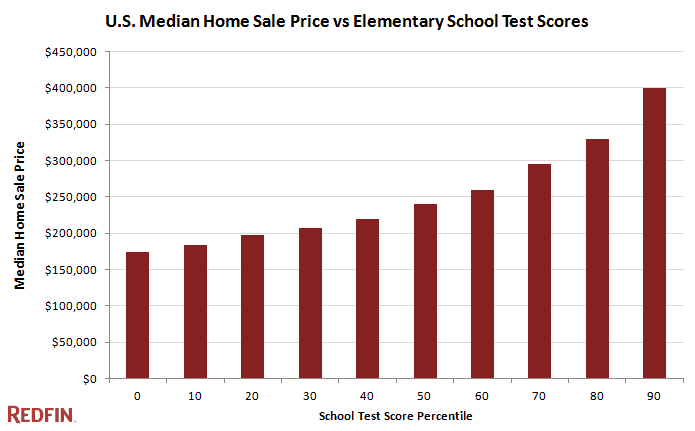
In the United States, housing prices in the zones of highly ranked public schools are remarkably higher than those served by lower ranked schools. Although we were somewhat floored by the higher prices in many zones, the good news for parents is that there are several neighborhoods left where homes are relatively affordable in highly ranked school zones.


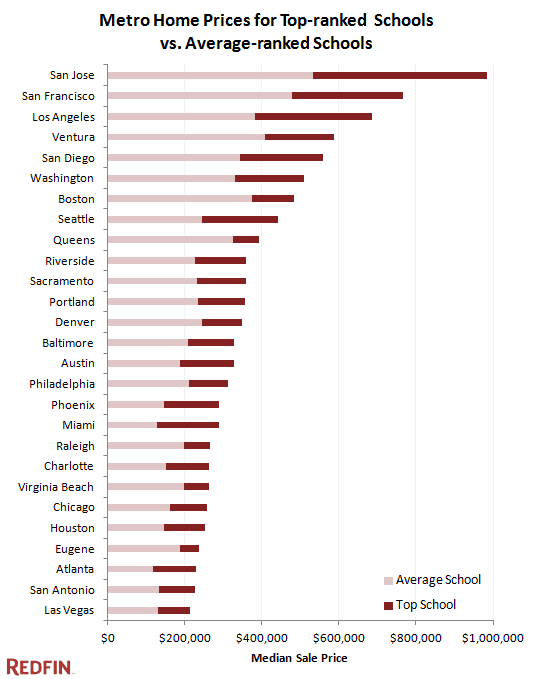
Everyone assumes that better school districts tend to have bigger homes, higher quality homes, larger lots, or a more prime location (views, quiet streets, etc). We’ve debunked that assumption. When accounting for size, on average, people pay $50 more per square foot for homes in top-ranked school zones compared with homes served by average-ranked schools. This means that the price differences for similar homes located near each other but served by different schools can range from tens to hundreds of thousands of dollars.

Every metro area in this report has higher prices for homes served by top-ranked public elementary schools. Coastal California leads the way in terms of cost, with homes in the highest-ranking school zones running from $300,000 more in Los Angeles to nearly $500,000 more in San Jose. Although the dollar cost differences in Miami and Phoenix were not as great, homes in the top-ranked school zones were still more than twice the price of homes in the average-ranked school zones, going from about $150,000 to $300,000 in median home sale price.

In conclusion, Schools do drive the home prices high and I do see that everyday in Houston. Katy, Sugarland, Woodlands has some good schools and we all know that people are flocking to buy homes in those areas compared to any other suburb. We might be sending kids to public schools but these schools are run by our Tax money which we pay for our property. Indirectly we are paying for schools for better education for our kids and other kids in our neighborhood. I don’t see anything wrong with it compared to sending to private schools.

Source: Redfin.com